Cincinnati Center for Addiction Treatment
Hillbilly ElegyThe Cincinnati Center for Addiction Treatment, which the family called the CAT house, was where Mom entered rehabilitation after Papaw’s death. It was more than a place for visits: its family sessions brought addiction and its effects into the open, making Lindsay’s unrecognized caregiving and J.D.’s changing view of his sister part of the treatment’s emotional landscape.
Admission and Family Context
Mom’s stay followed a long deterioration that J.D. had not understood at the time. She had begun taking prescription narcotics not long after the family moved to Preble County; what J.D. believed began with a legitimate prescription developed into stealing medication from patients and becoming so intoxicated that she once rollerbladed through the emergency room at Middletown Hospital, where she later lost her job. Papaw’s death, in J.D.’s retrospective account, turned a semi-functioning addict into someone unable to follow basic adult norms. With Mom in rehabilitation, the family’s earlier routine—J.D. dividing his time between Mom’s and Mamaw’s homes, with an escape route when life at one became difficult—was permanently altered.
The center’s role also came amid practical instability outside treatment. J.D. and Lindsay received a school-district letter warning that his unexcused absences could bring a summons or prosecution, but they did not know what to do without a legal guardian available to sign it. Lindsay forged Mom’s signature, and the letters stopped. The episode sits alongside the family’s visits as evidence that Mom’s treatment did not immediately resolve the responsibilities and disruptions surrounding her children.
Visits and Family Sessions
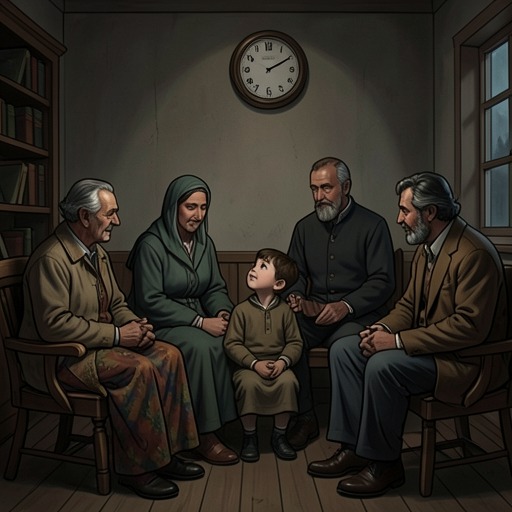
The family visited Mom at the center on designated weekdays and weekends. Wednesdays were devoted to group activities, described as training for families. Each family sat at its own table in a large room for discussions about addiction and its triggers. In one session, Mom explained that she used drugs to escape the stress of paying bills and to dull the pain of Papaw’s death. In another, Lindsay and J.D. learned that ordinary sibling conflict could make it harder for Mom to resist temptation. The sessions thus connected the family’s daily pressures to Mom’s drug use without making the children’s conflicts the whole explanation for it.
These meetings could be raw rather than orderly lessons. J.D. recalls other families in the hall—families who were either black or white with Southern accents—screaming and fighting; children told parents they hated them, while parents sobbed, begged forgiveness, and then blamed their families. The group setting made private family turmoil audible alongside other households’ distress. For J.D., it was an early encounter with the wider world of American addiction, beyond the crises he had already known at home.
Lindsay’s Caregiving and Mom’s Recovery
At one session, Lindsay told Mom that she resented having to act as caretaker after Papaw’s death instead of being able to grieve. She also described the hurt of watching J.D. grow attached to one of Mom’s boyfriends, only to see him leave. Hearing her confront their mother changed J.D.’s understanding of his sister: whether because of the setting or because Lindsay was almost eighteen, he began to see her as the real adult. The treatment sessions gave voice to a burden that had been present in the family but had not previously appeared so clearly to him.
Mom’s rehabilitation proceeded, and her condition apparently improved over time. Sundays were set aside for unstructured family visits. The family could not take her off-site, but they could eat, watch television, and talk together in something closer to an ordinary routine. Those Sundays were usually happy, though Mom once angrily objected that Lindsay and J.D. had grown too close to Mamaw, insisting, “I’m your mother, not her.” J.D. understood the outburst as evidence that Mom had begun to regret the closeness her own choices had helped create between her children and their grandmother.
Significance in the Family’s Story
The CAT house marks a transition from the family’s chaotic home life to a structured setting where addiction was discussed in groups and family roles could be named. Yet the treatment did not erase the consequences of instability: Lindsay still carried responsibilities, J.D. still faced school absences, and Mom’s recovery existed alongside conflict over the children’s attachment to Mamaw. The center’s importance in the memoir lies in this tension. It offered a setting for Mom’s improvement and for more honest family encounters, while making visible how much the children had already had to manage.
Later, J.D. contrasts the unsettled years before he moved permanently in with Mamaw with the consistency of living in her house through tenth, eleventh, and twelfth grades. In that retrospective account, the CAT house belongs to the chain of crises that preceded stability; it is one of the places where the costs of family disruption became legible, not a simple endpoint to them.